

ABRASIVE BELTS FOR METALWORKING
Narrow abrasive belts for deburring and surface finishing
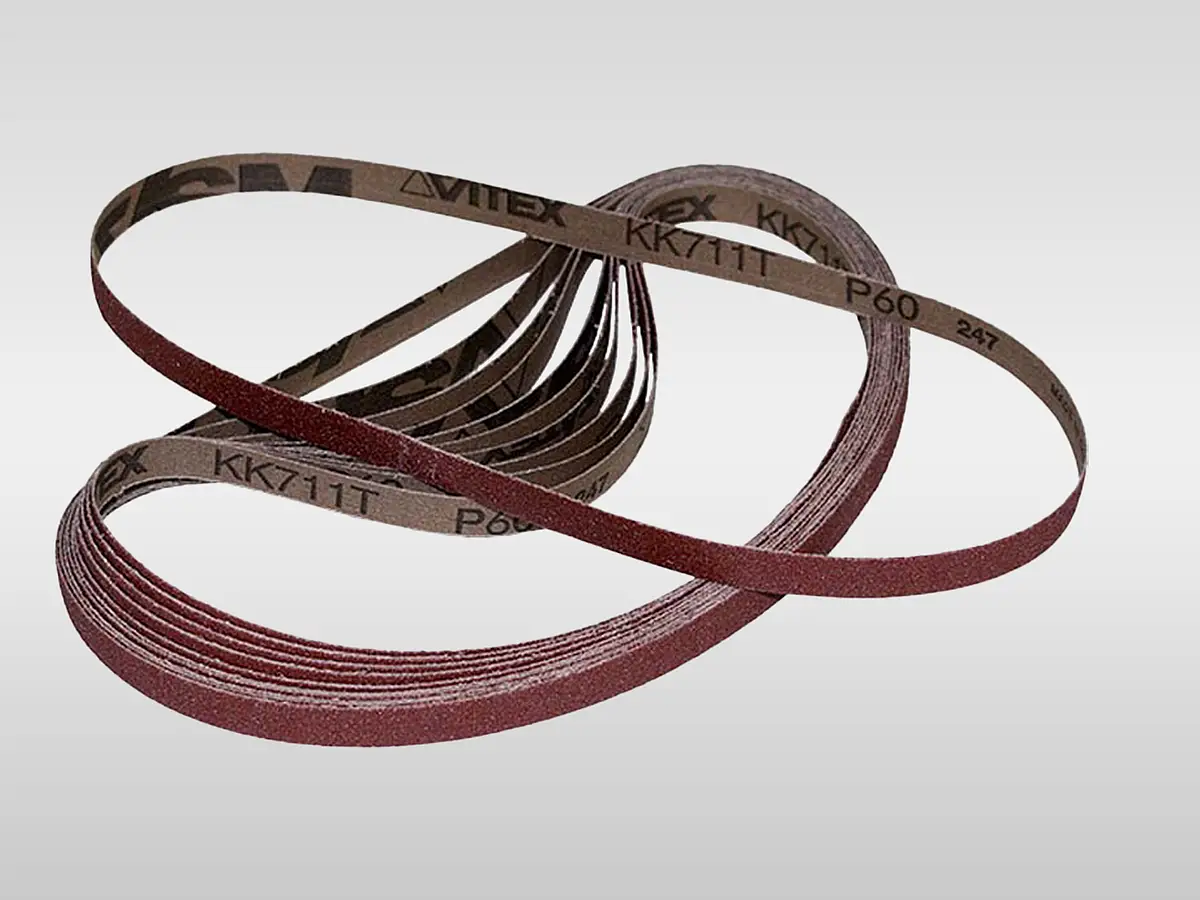
Narrow belts are coated abrasives for suitable belt machines and machining tasks. Choose them by workpiece material, initial surface, required stock removal and finish; the existing belt size alone does not determine the result.
01
Selection criteria
Which narrow belt suits the machining task?
Start with the workpiece material, initial condition and target finish: is the belt meant to remove burrs or prepare a surface for the next operation? Then check stock removal, service life, belt width and length, and your machine's specifications. In the listed VSM range, KK711X and KK711Y differ in their cloth backing; abrasive grain, grit and backing must therefore be considered together.
02
NARROW BELT RANGE
Narrow belts in the VSM range
The system listing shows narrow belts assigned to this category. Compare dimensions, grit, backing and suitable workpiece materials in each product's specifications.
No products found
No products are currently listed in this category. Request a call back and we will help you find the right product.
Request a callback03
SELECT BY PROCESS
Consider grit, cloth backing and machine together
The listed VSM KK711X and KK711Y use aluminium oxide and a full synthetic resin bond, but their specified cloth backings differ. For KK711X, the catalogue specifies X-polyester or X-cotton depending on grit; for KK711Y, Y-polyester or Y-cotton. This does not make them universally interchangeable: the workpiece material, pressure range, edge load and required finish must suit the specific product.
For a converted belt, the confirmed manufacturing matrix gives an overall range for abrasive belts of 6–610 mm in width and 283–16,500 mm in length; the limits cannot be combined arbitrarily. Krückemeyer GmbH checks the suitable coated abrasive, belt dimensions and belt joint against the material, machine and application. Tell us which belt you currently use and what problem occurs in the process so the selection can address it.
04
NARROW BELT SELECTION QUESTIONS
Where should narrow belt selection begin?
Begin with the workpiece material, initial surface and desired result. A narrow belt used for deburring must meet different requirements from one used for a finer intermediate sanding step. Also check the belt machine, belt width and length, pressure and edge contact. The belt currently in use is a useful reference: provide its product details and explain whether stock removal, service life or surface finish is the problem. Only then can a specific coated abrasive be assessed.
How do VSM KK711X and KK711Y differ in the listed range?
The product data specify aluminium oxide grain and a full synthetic resin bond for both narrow belts. One documented difference is the cloth backing: KK711X is specified with X-polyester or X-cotton depending on grit, while KK711Y is specified with Y-polyester or Y-cotton. The listed variants also differ in dimensions and grits. The product name alone does not approve either belt for the same machine or grinding process. Compare the specific variant with the workpiece material, machining goal and machine specifications.
What details does Krückemeyer need for a converted narrow belt?
First state the coated abrasive selected or currently used, the required belt width and length, and your machine. Add the workpiece material, contact area, working method and desired grinding result. Krückemeyer GmbH cuts suitable coated abrasives and makes abrasive belts with a belt joint. Whether a particular material and dimension can be combined is checked case by case; the confirmed overall limits for abrasive belts cannot be combined arbitrarily at their extremes.
When should a non-woven belt be considered instead of a narrow belt?
If the task calls for non-woven surface finishing rather than grinding with a cloth belt, the separate non-woven belt category is a suitable next selection route. The company source confirms that Krückemeyer GmbH also customises non-woven belts in application-specific widths and lengths. A non-woven belt is therefore not an automatic substitute for a listed cloth narrow belt. The initial surface, required finish, machine and specific non-woven product determine whether a change is appropriate; these details should be reviewed together first.
05
Request advice
Describe the workpiece material, initial surface, required result and machine. The belt currently in use and the specific problem help us assess product selection, belt dimensions and suitable conversion.
Discuss a narrow belt for your process
A sound choice depends on the workpiece, belt machine and machining goal. Send us your application details or enquire about specific listed products.

ABRASIVES ADVICE
Jürgen Müller
Contact for products
Jürgen Müller will discuss your workpiece material, belt machine and required machining result.