

COATED ABRASIVES · CLOTH BACKING
Cloth abrasive belts for contoured and flat surfaces
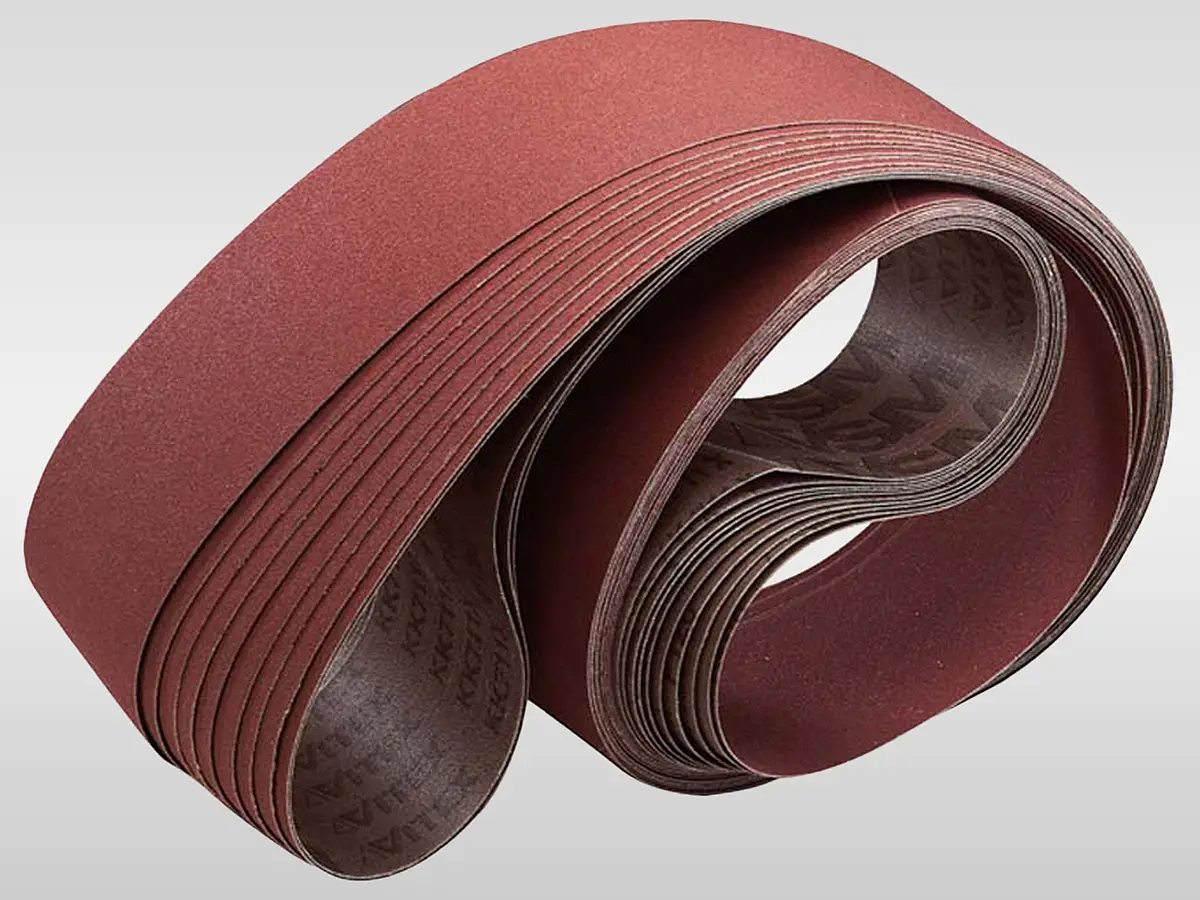
Cloth abrasive belts combine abrasive grain and bond with a woven backing. The right construction depends on the workpiece material, starting surface, required stock removal, contours and belt machine. We help you select a product and assess suitable belt dimensions.
01
Selection criteria
Which cloth backing suits your grinding process?
Start with the material and its condition: does the belt need to remove stock, follow a contour or produce a defined finish? Flexible J-weight cloth adapts to contours; firmer X- and Y-weight cloth may be suitable for higher loads, depending on the product. Assess abrasive grain, grit and bond together with contact pressure, wet or dry operation and the machine in use. P, A and plus-marked grit designations belong to different systems and are not interchangeable without product evidence.
02
CLOTH ABRASIVE BELT RANGE
Cloth abrasive belts in the range
The system listing shows cloth abrasive belts assigned to this category. Check each product for grain, backing, dimensions and suitability for your processing step.
No products found
No products are currently listed in this category. Request a call back and we will help you find the right product.
Request a callback03
SELECT BY APPLICATION
From the belt in use to the required finish
A belt currently in use is a useful starting point, but not an automatic recommendation for a new task. The flexible J-weight backing of the 3M Gewebeschleifband 307D supports work on contours; the 3M Gewebeschleifband 384F uses X-weight polyester cloth for general grinding at low to medium pressure. The deciding factor is whether stock removal, contour conformity or the target finish matters most. Compare service life and surface finish under your actual operating conditions as well.
When considering a different belt, tell us the workpiece material, starting condition, machine, belt dimensions, current product and specific problem. Krückemeyer GmbH converts suitable coated abrasives into belts; the material, dimensions and belt joint are assessed for the requested design. For other product forms, see the separate ranges of paper abrasive belts and nonwoven abrasive belts.
04
QUESTIONS ABOUT CLOTH ABRASIVE BELTS
How does a cloth abrasive belt differ from a paper abrasive belt?
The first difference is the backing. A cloth abrasive belt has a woven backing whose flexibility and tear resistance vary by construction; a paper abrasive belt uses paper. Flexible cloth can be a useful choice for strongly contoured workpieces, while a firmer backing may be needed under greater load. The backing alone does not establish suitability: abrasive grain, bond, workpiece material, belt machine and target finish all matter when selecting a specific product.
Which cloth backing is suitable for contours?
A flexible cloth backing is often the starting point for contoured work. The manufacturer describes the J-weight cloth of the 3M Gewebeschleifband 307D as adaptable to contoured workpieces. Firmer backings may be relevant at higher loads, but they behave differently around radii and edges. Check the exact belt construction, contact pressure and machine before changing from your current backing. Assess the required finish on the actual workpiece.
Are P-grit, A-grit and plus-marked grit grades directly comparable?
No. These designations come from different product and grit systems. 3M assigns its precision-shaped grain with a plus sign to familiar grit series only on an empirical basis; Trizact products use A designations for structured abrasives. The same or a nearby number therefore does not establish the same cutting behaviour or finish. To change products, assess the specific belt, processing step and surface under the intended operating conditions.
What information does Krückemeyer need for a converted cloth abrasive belt?
Provide the source material or product currently in use, the required belt width and length, and the machine. The workpiece material, initial condition, required stock removal or finish, contact pressure, and wet or dry operation help with technical selection. Krückemeyer GmbH converts suitable coated abrasives into belts and checks material, geometry and belt joint for the requested design. A particular dimension or combination of production limits is confirmed for the individual case.
05
Request advice
Describe the workpiece material, machine, belt dimensions, current process and desired surface finish. We will assess the product and possible conversion with you; no response time is promised.
Discuss the cloth abrasive belt for your task
Send us your requirements for stock removal, surface finish and belt dimensions. If you have already selected products, you can use the enquiry list.

ABRASIVES ADVICE
Jürgen Müller
Contact for products
Jürgen Müller will discuss your workpiece material, required finish and suitable cloth abrasive belts with you.